Data Structures
- Linked List
- Queues
- Dynamic Array
- Skip List
- Binary Tree
- Heap
- Associative Array
- Bit Array
- Trie
- Record
- Union
- Set
Linked List
A linked list is a collection of elements whose order is not given by the physical placement in memory but each element points to the next.
Each element, or node, contains both data and a reference to the next node in the sequence. Inserting and removing elements is quicker than with arrays: there’s no need to rearrange the whole structure each time but:
- a linked list use more memory (data + reference)
- nodes must be read in order
- longer access time as nodes are not contiguosly stored
History
First developed in 1955 for the IPL language. In 1958 linked lists were implemented in Lisp. The Flex family of file systems used doubly linked lists for their file structure, as the IBM’s T53/360 operating system.
Versions:
- Singly Linked List
- a singly linked list contains nodes which have a data field and a next field, pointing to the next node in the list
- Doubly Linked List
- a doubly linked list contains, besides the next field and the data field, another link field that points to the previous node in the list. This is called the forward or backward or previous field
- Multiply Linked List
- a multiply linked list is like a doubly linked list, only with multiple number of fields pointing in different directions. Actually a doubly linked list is just a special case of a multiply linked list
- Circular Linked List
- in a circular linked list the last node, instead of being null, is a pointer to the head of the list, making it circular. It is also called open or linear list
- Unrolled Linked List
- a variation of a linked list in which each node stores multiple elements, in the form of arrays
- Association List
- an early implementation of an associative array, common in Lisp and later functional languages (Scheme, OCaml, Haskell). In Lisp is also called alist
- XOR Linked List
- an implementation of a doubly linked list that use bitwise XOR operation to store more efficiently the forward and backward field. It stores both in a single field by XORing the 2 fields’ addresses. To parse the list then it’s needed also the address of the 2 consecutive elements other than the XORed field of the current one.
- VList
- a singly linked list of arrays whose sizes decreases geometrically, from the first to the last. Usually the first array contains roughly half the total number of elements.
A Sentinel Node may also be implemented as the first or last node instead of using null values, to speed up operations (removing the need for an expensive branch operation to check for null). It does not hold any data.
Empty lists are without data fields. Lists with only sentinel nodes are also considered empty.
Hash Linking are two arrays, one with the data and another with the links, both with the same indices.
A Stack is a sort of a singly linked list which allows pop and push operations only on the first node, the top of the stack. Historically they have been invented in Munich and independently in Australia around 1954-1955. Stacks are commonly implemented through arrays and linked lists. They are LIFO, last in first out, data structure.
Queues
Similarly to stacks, queues are a collection of data in which addition is made at the back only and removal at the front only. These are respectively known as enqueque and dequeue operations. Doubly or singly linked lists are commonly used to implement queues.
Deques or double-ended queues are queues in which elements can be added and removed both on front and back of the queue. Also known as head-tail linked list.
Priority Queues are standard queues whose values are pre-ordered for priority, with the top value being the highest priority one.
Dynamic Array
Also called growable array, resizable array, dynamic table, mutable array or array list is a data structure that is made of 2 parts of a fixed size array: the first stores the actual elements and the second is reserved. This makes very fast to add elements to the array afterwards, up until the total capacity of the array (size is called the size of the allocated elements).
Variants:
- Gap Buffer
- a dynamic array type that allows efficient insertion and deletion operations near the same location
- Hashed Array Tree (HAT)
- an hashed array tree has a top-level array where each element contains a
power of two number of leaf arrays. All leaf arrays are the same size of
the top level array (the directory). It’s similar to a hash table. It
can hold at most m² elements, where
mis the size of the directory
- an hashed array tree has a top-level array where each element contains a
power of two number of leaf arrays. All leaf arrays are the same size of
the top level array (the directory). It’s similar to a hash table. It
can hold at most m² elements, where
- Sparse Array
- an array in which most of the elements have the same value (the default
value, usually 0 for array of numbers and
nullfor array of objects)
- an array in which most of the elements have the same value (the default
value, usually 0 for array of numbers and
- Multimap
- a generalization of a map or array in which more than 1 value may be
associated and returned for a single key. Implementations are:
container(C++),MultiMap(Java)
- a generalization of a map or array in which more than 1 value may be
associated and returned for a single key. Implementations are:
- Suffix Array
- a sorted array of all suffixes of a string. Also known as PAT array
- FM-index
- a suffix array that undergoes the Burrows-Wheeler transform of the input text. It is used to efficiently find the occurrences of a pattern within the text
- Judy Array
- a high performance, low memory usage implementation of an associative array. Judy arrays may be sparse, containing large ranges of unassigned indices. Similar to a highly optimised 256-ary trie
Implementations:
std::vector(C++),ArrayList(Java and .Net),List<>(.Net 2.0),OrderedCollection(SmallTalk),list(Python)*
Skip List
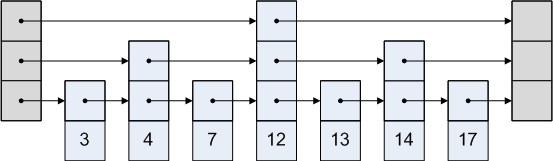
Basically, a skip list is a normal linked list that has multiple levels, themselves linked lists. The bottom level is a linked list linking all elements, one after another; then the subsequent levels may link only the odd elements, jumping one or two at the time and so on up until the topmost level that usually links only the head to the middle and then the tail. They skip elements, thus the name.
Binary Tree
A binary tree is a data structure in which each node has at most 2 child nodes. Nodes with children are called parent nodes and there may exists a root node, the origin of all nodes. Definitions:
- root is the top node
- child is a node directly connected to another
- parent is an immediate ancestor of a node
- siblings are nodes that share the same parent node
- neighbor is a parent or child node of another
- descendant is a node reachable by proceeding from parent to child
- ancestor is a node reachable by proceeding from child to parent. Also defined as a node
nof nodeqif it exists on the path from root to nodeq. It is then a descendant ofn - leaf, or external, is a node with no children
- branch, or internal, is a node with at least one child
- edge the connection between one node and another
- path a sequence of nodes and edges connecting a node with a descendant
- distance the number of edges on the shortest path between two nodes
- depth of a node is the length of the path from the root to the node. Sometimes called level
- depth of a tree is the length of the path from the root to the deepest node. Sometimes called height
- level is the number of edges between a node and root + 1
- height is the number of edges on the longest path between a node and a descendant leaf
- width the number of nodes in a level
- breadth the number of leaves
- the height of tree is the height of root
- size of a node is the number of descendants it has, itself included
- in-degree of a node is the number of nodes arriving at that node
- out-degree of a node is the number of nodes leaving that node
- subtree is a node in a tree with all its descendants
Variants:
- Rooted Binary Tree
- a tree with a root node in which each leaf node has at most 2 children
- Full Binary Tree
- a tree in which every node, not only the leaves, has 2 children. More precisaly, every node has either 0 or 2 children. Also called proper binary tree, 2-tree or strictly binary tree
- Perfect Binary Tree
- a tree in which all leaves are at the same depth or same level and in which every parent has exactly 2 children
- Complete Binary Tree
- a tree in which every level, except possibly the last, is completely filled and all nodes are as far left as possible
- Balanced Binary Tree
- a tree in which the depth of the 2 subtrees of every node differ by 1 or less; more generally, it is a binary tree where no leaf is much farther away from the root than any other leaf.
- Degenerate Tree
- a tree where each parent node has only 1 child node. Basically not, performance-wise, a linked list
- Dancing Tree
- a self-balancing tree that balances its nodes only when flushing data to the disk, to gain performance by delaying optimization. Used in the Reiser4 filesystem
- B-tree
- a tree that’s not limited to 2 child nodes. Vastly used in databases and filesystems
- B+-tree
- a b-tree that stores copies of the keys in the internal nodes. Keys and records are normally stored in leaves. A leaf node may include a pointer to the next leaf node
- B*-tree
- the b*-tree balances more neighboring internal nodes to keep them more densely packed. It requires non-root nodes to be at least 2/3 full instead than 1/2. To achieve this, instead of splitting up a node when it gets full, its keys are shared with a node next to it. Only when both nodes are full they get split up in a third node
- B+tree
- as a b-tree but with usually large number of nodes and in which all nodes contain only keys (not pairs) and to which an additional level is added at the bottom with linked leaves
- Red-Black Tree
- a version of a balanced binary tree where each node is “painted” in two distinct colours, tipically red and black, in such a way that the resulting tree won’t be significantly unbalanced. Tracking the colour of every node it’s fast because it only requires 1 bit (just 2 colours). The root node is usually considered black, all leaves and the children of the same node are black too, the rest is red
- AA Tree
- named after its inventor, Arne Andersson, is a variant of a red-black tree that allows the red nodes to be added only in the right direction. No red node can thus be a left sub-child
- AVL Tree
- the first implementation of a balancing binary tree, named after its inventors (G.M.Adelson-Velskii and E.M.Landis)
- Splay Tree
- a self balancing tree that adds an operation, splaying, that rearranges the tree itself by putting a specific element as the root, making very quick to access it again
- 2-3 Tree
- a tree where every node with children has either 2 children and 1 data element or 3 children and 2 data elements. Nodes on the outside of of the tree, leaf nodes, have no children and 1 or 2 data elements. It’s similar to the AA tree
- 2-3-4 Tree
- a tree commonly used to implement dictionaries. Numbers mean a tree where every node with 2 children has either 2 children and 1 data element or 3 children and 2 data elements or 4 children and 3 data elements. Also called 2-4 tree
- Cartesian Tree
- a binary tree derived from a sequence of numbers. Each number has a node in the tree, with left nodes coming before the root in the sequence while the right subtree consists of later numbers. The tree has the heap property, the parent of any non-root node has a smaller value than the node itself
- Rope
- a binary tree used to store strings. Leaves contain a short string; each node has weight equal to the length of the string plus the sum of all the weight in its left subtree. Thus a node with 2 children divides the whole string in 2 parts: the left part stores the first part of the string, the right part stores the second part and its weight is the sum of the left child’s weight and the length of its contained string. Also called cord
- Threaded Binary Tree
- a binary tree that has all the right child pointers that would be normally be null point to the successor of the node and all the left child pointers, that would too be normally null, point to the predecessor of the node
- Ternary Tree
- a tree in which each node has at most 3 child nodes, usually called left, mid and right
BSP Tree
Binary Indexed Tree
A complete and clear answer on SO about the intuition behind a Binary Indexed Tree.
Heap
a tree that satisfies the heap property: if A is a parent node of B, then
key(A) is ordered with respect to key(B). The same applies across the heap.
Thus, either the keys of parent nodes are always greater than or equal to those
of the children and the highest key is the root (this kind of heap is called
max heap) or the keys of the parent node are less or equal to those of the
children (min heap)
Variants:
- Beap
- a data structure where every node has 2 parents and 2 children, unless it is the first or on the last level. Also known as bi-parental heap
- Binary Heap
- very similar to a binary tree but with two additional constraints: it is a complete binary tree, thus all levels are fully filled except maybe the last, and each node is greater or equal to each of its children, making thus a heap and not just a tree
- Fibonacci Heap
- a heap consisting of a collection of trees, even separated, satisfying the minimum-heap property (every child is always greater or equal to the parent)
- Leftist Heap
- a variant of a binary heap. Every node has an s-value which is the distance to the nearest leaf. Unlike binary heaps, a leftist heap (also called leftist tree) is very unbalanced and mantained so the right descendant of each node has the lower s-value
- 2-3 Heap
- a heap similar to the 2-3 tree
- d-ary Heap
- a generalization of a binary heap in which the nodes have
dchildren instead of 2. Thus a binary heap is a 2-heap. Also simply called a d-heap
- a generalization of a binary heap in which the nodes have
- Skew Heap
- a heap similar to a binary heap but without structural constraints. Only two conditions must be satisfied: the general heap order must be enforced and every operation on two skew heaps must be done using a special skew heap merge
Implementations:
make_heap,push_heapandpop_heap(C++),java.util.PriorityQueue<E>(Java),heapq(Python),SplMaxHeapandSplMinHeap(Php),Heap(Perl),heap(Go)*
Associative Array
Also called map or dictionary is a collection of pairs (key, value) such that each keys appear at most once in the collection
Variants:
- Hash Table
- an associative array that uses a hash function to compute an index into an array of buckets or slots from which the correct value can be found. Hash collisions, different keys that are assigned by the function to the same bucket, can happen
Implementations:
dictionary(Smalltalk, Objective-C, .Net, Python),hash(Perl, Ruby),map(C++, Java, Go, Clojure, Scala),hash table(Common Lisp, PowerShell),table(Lua)
Bit Array
An array that stores bits, as in 0 or 1 values. Known also as bitmap, bitset, bit string, bit field or bit vector
Implementations:
bitfield(C),BitSet(Java),bitset(C++),BitArray(.Net)
Trie
Also called digital tree or prefix tree, the trie is used to store an associative array where keys are usually strings. Differently from a binary search tree, no node in the tree stores the key associated with that node; its position in the tree defines the key with which it is associated. All the descendants of a node have a common prefix of the string associated with that node, and the root is associated with an empty string. Values are associated with leaves, not every node.
Variations:
- Radix Tree
- a space-optimized trie where each node with only one child is merged with its child, resulting in every internal node having 2 children. Also called patricia trie, _radix trie or compact prefix tree
- Suffix Tree
- a tree that presents the suffixes of a given string in a way that allows fast operations on it. Its edges are labeled with strings, such that each suffix of the string corresponds to exactly one path from the tree’s root to the leaf. The suffix tree is like a radix tree for the suffixes of a string
- B-Trie
- a trie that can store and retrieve variable-length strings efficiently on disk
Record
A value that contains other values, generally in fixed number, order and indexed by names. Record elements are called fields or members. Unlike arrays, records have fixed number of fields, all with a name, and with different types among them. Also called tuple, struct or compound data
Union
Very similar to records, an union may have multiple elements but only one at the time can have a value as unions’ elements are stored at a single spot in memory and thus setting any value will overwrite all other elements’ values. As an advantage, they are clearly more compact than records.
Variants:
- Tagged Union
- an union that has a tag field that signals which type is in use and which field is active. Also known as variant, variant record, discriminated union, disjoint union or sum type
Set
A structure that can store any arbitrary value, in no particular order, and no repeated value. It can be static or frozen, not modifiable after the creation, or dynamic or mutable, that are modifiables.
Implementations:
Set(Java),NSSetand similar classes (Objective-C),setandfrozenset(Python),HashSetandSortedSet(.Net),set(Ruby),Data.Set(Haskell)
Variations:
- Multiset
- a generalization of a set, allowing repeated/duplicates values in either identical or different objects storing the same value. Also known as bag